

The Real History of Blair Hills, Culver City: A Land Grant and a Will Rogers Connection
Blair Hills is one of those Culver City pockets people drive past for years without knowing the name. A few hundred homes on a hillside off La Cienega, quiet streets, big trees. Someone asked me the other day whether Will Rogers used to own the land that became Blair Hills. It’s a good question, and the answer is more interesting than a simple yes or no.
Before the neighborhood
The land that became Blair Hills was once part of a Mexican land grant called Rancho Rincon de los Bueyes, which translates to “corner of the oxen.” The grant was made in 1821 to Bernardo Higuera and a partner, and the Higuera family was one of the oldest non-Native families in what is now Culver City, Palms, and the neighborhoods around them.
For the next hundred years these hills were used for grazing and ranching, and then for oil. By the early twentieth century there were wells and exploratory drilling across the slopes.
So did Will Rogers own it?
Sort of. This is where the local story usually gets garbled.
The Will Rogers with the rope tricks, the newspaper column, and the 186 acre ranch in Pacific Palisades was Will Rogers Sr. He died in a plane crash in 1935, and he never owned land here.
His son did. Will Rogers Jr., born in 1911, owned a ten acre parcel up in these hills. He was a congressman for this part of Los Angeles from 1943 to 1944, he published the Beverly Hills Citizen newspaper, and he played his own father in a 1952 film about Rogers Sr.’s life. So when people say “Will Rogers owned Blair Hills,” they are half right. It was the son, and it was ten acres, not the whole hill.
The family connection runs deeper than the deed, though.
Will Rogers Sr.’s chauffeur was a performer named Ben Pitti, who had ridden in Wild West shows and taught the three Rogers children to ride and rope. The two families stayed close. In 1951, Ben’s sons Carl and Paul moved onto Will Rogers Jr.’s Blair Hills property to look after the horses, and the Pittis later bought the parcel. Carl worked as a Hollywood stunt man and built his own house on Wrightcrest, framing the beams from the outside in until the last one fit at the entry.
For a few years in the early 1950s, this hillside was a working ranch where studios sent actors to learn to ride and handle a gun for westerns. Robert Taylor, Glenn Ford, and Zsa Zsa Gabor all came up. Carl kept a thank you letter from Joan Crawford for his help on the shootout at the end of the 1954 western “Johnny Guitar.” The Pittis sold the ranch in 1956.
The horse in the oil sump
Here is the detail that ties the oil history to the neighborhood you see today.
Across the road from the Rogers house was an oil sump, a pit where oil, sand, and water from the nearby wells got dumped. In January 1952, one of the Pitti horses got loose, ran down Wrightcrest, and went straight into it. The Los Angeles Times covered the story. It took five people and a tractor to pull the horse out.
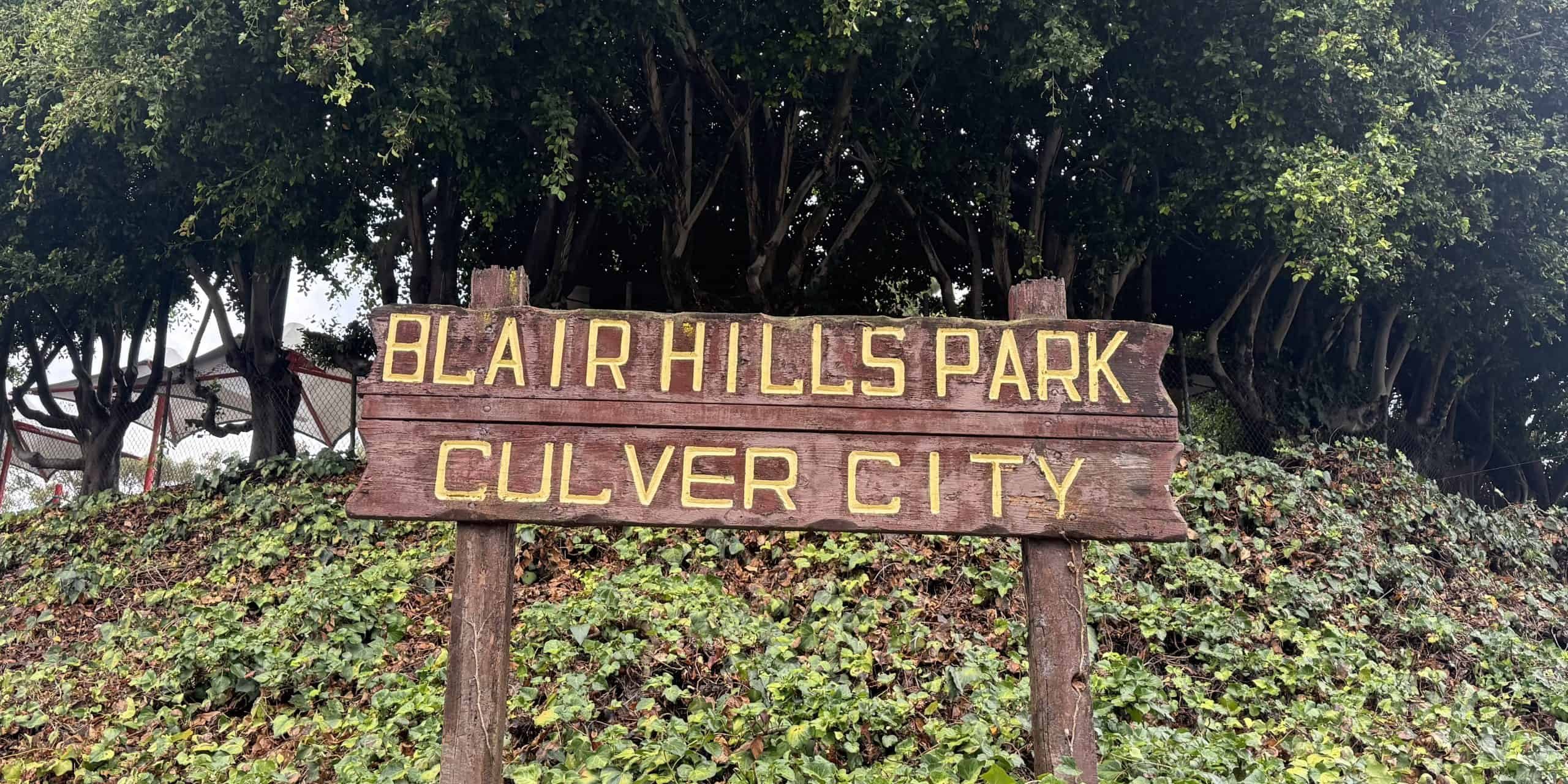
That same sump is now Blair Hills Park. Neighbors spent years in the early 1960s pushing the city to clean it up and turn it into the park with the ball field and basketball court that families use now. When you take your kids there, you are standing on a filled oil pit.
How Blair Hills became Culver City
Culver City incorporated in 1917 as only 1.2 square miles. In 1921 it annexed most of what is now Blair Hills, along with an unincorporated island of Los Angeles County that stayed county land until 1955.
The neighborhood as we know it started in the early 1950s, when a builder called Stone and Stone bought the lower part of the hill and drew up plans for a tract of single family homes. They first asked the City of Los Angeles to annex the land. Los Angeles had a moratorium on new sewer connections at the time, so Stone and Stone took the project to Culver City instead. That is the whole reason Blair Hills is Culver City and not Los Angeles.
The name is not historic. Blair Hills was named for a grandchild in the Stone family, and several streets carry family names too: Stoneview, Blairstone, Vicstone, Lenawee for the builder’s mother.
The neighborhood that built itself
The first families moved in over Halloween weekend in 1955. Twelve houses on Vicstone Court, three on Lenawee, fifteen families, twenty nine children. There was a cement strike on, so the homes went in without porches or sidewalks until it settled the next year. One family had a telephone. Everyone else used the pay phone on the corner.
The people who bought here organized fast. They chartered a neighborhood association in December 1958. They negotiated with the school district for a local elementary school, since there were more than 200 children in the tract, and Linda Vista Elementary opened in September 1959. And they got the old oil sump turned into the park.
A lot of that first generation stayed. Some homes are still owned by the original families or their children.
What Blair Hills is today
Most of the houses are from the mid 1950s to the early 1960s, California ranch style, on a hillside grid that dead ends into open space instead of feeding traffic through. Stoneview Nature Center sits right at the edge of the neighborhood. You are close to downtown Culver City, the studios, and the rest of the Westside without being in the middle of any of it.
On the real estate front, I would not treat Blair Hills as one micro-market. A remodeled home with a view and a flat yard is valued WAY differently than an original 1956 house that needs the kitchen and systems redone, and both show up here. Homes do not come up for sale often and if you are thinking about buying or selling here, the useful conversation is about that specific house.
Sources: the Blair Hills Association neighborhood history (blairhills.org), with additional detail from Wikipedia on Rancho Rincón de los Bueyes and Will Rogers Jr.
About Nicole Strober
Nicole Strober is a Realtor® with Compass and a native Angeleno. Her core focus is Culver City, Beverlywood, Cheviot Hills, West Adams, Baldwin Hills, Ladera Heights and surrounding Westside neighborhoods, with additional transactions across Los Angeles including Highland Park, the San Fernando Valley, Burbank, and South LA. Under her brand, Strober Homes, she helps buyers and sellers navigate the Los Angeles real estate market with a strategic and hands-on approach, taking time to understand what matters most to each client and guiding them through the process from beginning to end.
Nicole Strober | Strober Homes
Thoughtful Guidance • Strategic Marketing • Exceptional Results
📞 424.744.7282 📧 Nicole@NicoleStrober.com 🌐 StroberHomes.com