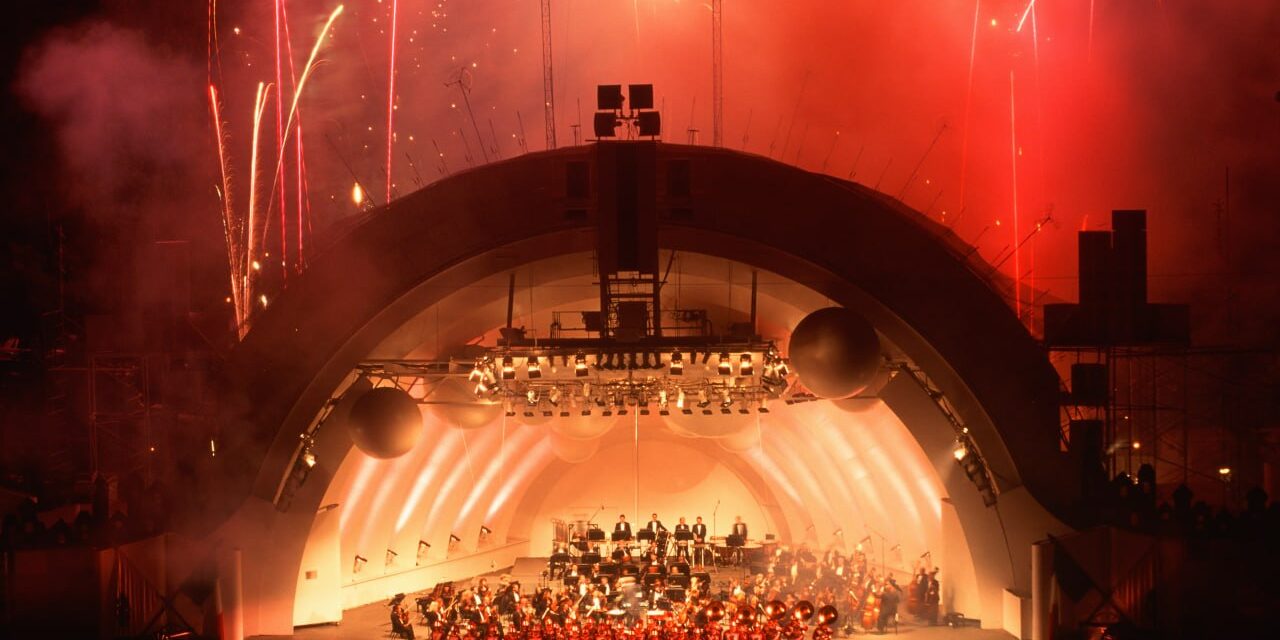
When the Hollywood Bowl first opened in 1922, it was more than a music venue. Los Angeles was young, ambitious, and determined to prove it was more than a Wild West town. The Bowl’s founders wanted a gathering place that would elevate the entire community, and they delivered an architectural and cultural landmark that still stands more than a hundred years later.
There’s a reason Angelenos plan their summers around the Hollywood Bowl season. Every year, from June through October, the venue draws people to the Hills for everything from the LA Philharmonic to jazz nights to classic film screenings with live orchestral accompaniment. It’s one of the world’s largest natural amphitheaters, with a capacity of nearly 18,000.
Culture First, Real Estate Second
In the 1920s, as the Bowl was still finding its footing, developers were racing to create luxury neighborhoods in its orbit. Outpost Estates was developed by Charles Toberman, the same man behind Grauman’s Chinese Theatre, El Capitan Theatre, Roosevelt Hotel and the Hollywood Masonic Temple, and it marketed itself as one of the most exclusive residential neighborhoods in the world. Whitley Heights and Hollywood Heights followed, all positioned as havens for the emerging Hollywood elite. Lot prices ranged from $2,500 to $55,000, serious money for that time.
What those developers understood was simple: people want to live near culture. Near the energy. The Hollywood Bowl became the anchor that justified premium home prices and attracted residents who could afford it. By the time the iconic permanent shell was built in 1926, the neighborhoods around it were already established as some of LA’s most desirable addresses.
The Bigger Takeaway
Nearly a century later, the Hollywood Hills is still one of Los Angeles’ most desired enclaves. Homes typically range anywhere from $1.5M to $4M, with luxury estates well above $10M. The Hollywood Bowl shaped the surrounding landscape, both literally and figuratively, and serves as a useful reminder when considering what makes any location worth the money. Laurel Canyon, Sunset Plaza, Nichols Canyon and the original 1920s developments command serious prices due to their rich history and proximity to my favorite LA landmark 🎶
