2026-10-20 · 7 min read · Los Angeles
Zone Zero Explained: What Los Angeles Homeowners Need to Know About the First 5 Feet
If you own a home in a fire zone in Los Angeles, you may have heard the phrase Zone Zero and wondered whether it means tearing out your landscaping. It does not, and the real rule is more reasonable than the headlines made it sound.
Zone Zero is a California rule about the first five feet around a home. It is a state rule, not a Los Angeles County ordinance, but it applies to homes inside the county that sit in the right kind of fire zone. This post covers what it says, where it applies, how long existing homeowners have, and what I would think about if you are buying or selling.
Is Zone Zero in effect yet?
Not yet. The California Board of Forestry and Fire Protection adopted the Zone Zero regulations on August 19, 2026. The Board’s Zone Zero page says it is still working with the Office of Administrative Law on a final review, and that the page will be updated when that review is complete and the Secretary of State publishes the final regulation.
The effective date is the day the regulations are filed with the Secretary of State. Every deadline below counts from that date, and as of October 20, 2026 it has not been set. Check the Board’s page for the current status before you act on a date.
Where it applies in Los Angeles
Zone Zero applies in two kinds of places. The first is State Responsibility Areas, where CAL FIRE is the primary fire agency. The second is areas mapped as Very High Fire Hazard Severity Zone inside Local Responsibility Areas, where a city, county, or special district handles fire protection. In Los Angeles County that second group is where most homeowners will land, and enforcement there belongs to the local fire department, not the state.
Not every home in Los Angeles is in one of these areas. Hillside and canyon-edge neighborhoods are far more likely to be than the flatter parts of the city, and the map is drawn by area, not by your individual house. The Office of the State Fire Marshal has a fire hazard severity zone map where you can look up an address. The state’s rules are a minimum, and a city or county can adopt a stricter standard or approve its own alternative that does the same job.
The three zones, in plain terms
California’s defensible space system has three zones, measured from the walls of the house.
- Zone 0 is the first five feet. It exists to keep embers from landing on something that can burn right next to the house.
- Zone 1 is five to thirty feet. It has been in place since 1965. The goal is to keep fire from running straight to the house, with dead growth removed and gaps between plantings.
- Zone 2 is thirty to one hundred feet, or to the property line if that comes first. It has been in place since 2006. The goal is to slow an approaching fire, mostly by removing dead vegetation and trimming so fire cannot climb from the ground into the trees.
Zones 1 and 2 are not new. Zone Zero is the new piece.
What Zone Zero actually requires
The five feet is split into two parts.
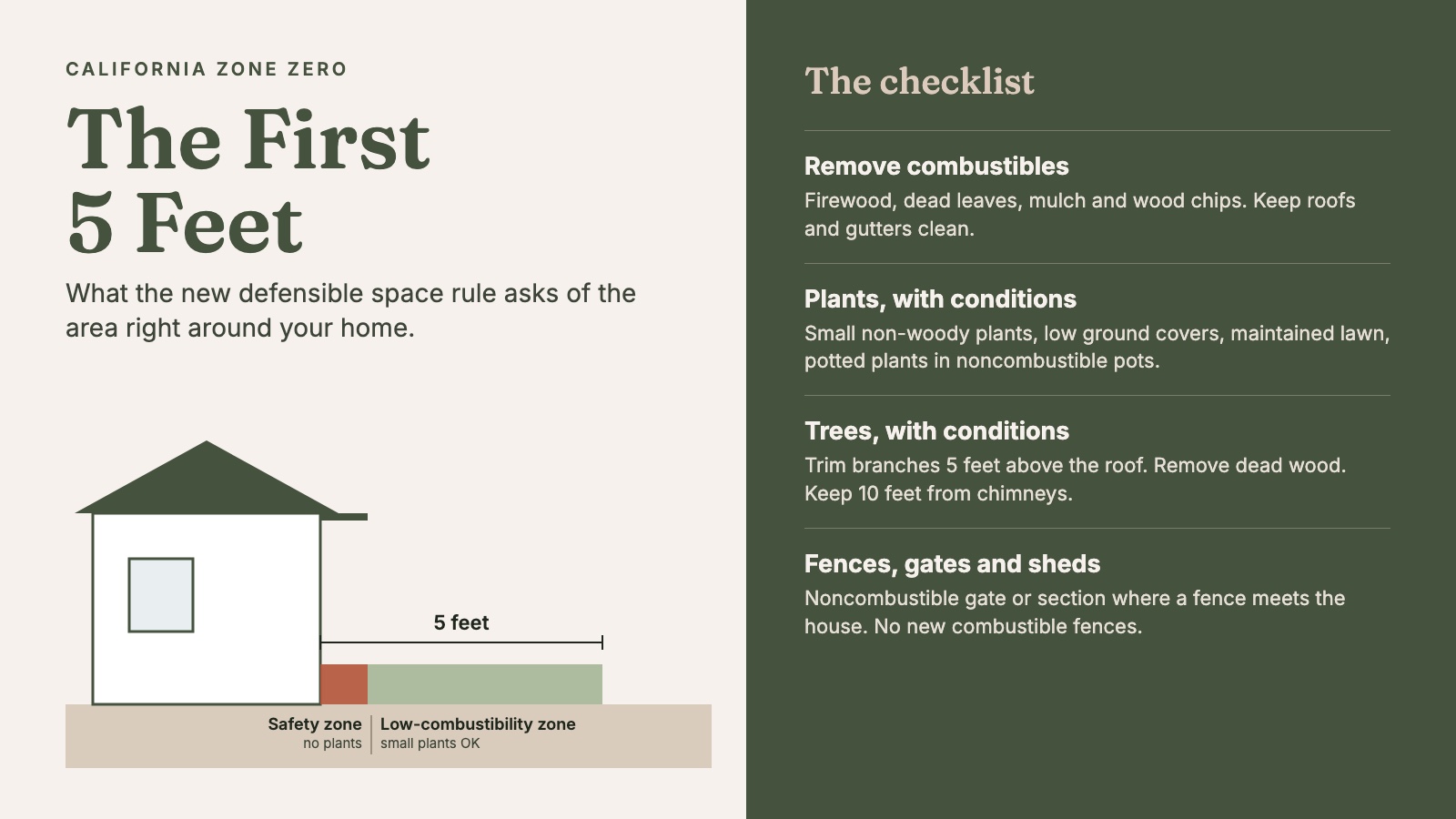
The first part is the safety zone, right against the house. It has to be free of vegetation and anything that burns. It runs a minimum of one foot from the wall or out to the edge of the eave, whichever is greater, two feet from windows, glass doors, and vents, and five feet around attached decks, stairs, and pergolas. Combustible mulch and firewood storage are out, and combustible fences or gates attached to the house have to be replaced.
The second part is the rest of the five feet, called the low-combustibility zone. Here the rules are softer. Well-maintained non-woody plants up to 18 inches tall are allowed, such as bulbs, poppies, and non-thatching succulents. Lawn and ground covers are allowed if kept under three inches. Potted plants are allowed in noncombustible containers under five gallons.
Roofs and gutters have to stay clear of leaves and debris. Existing trees can stay if they are maintained, with ladder fuels trimmed, no branches within five feet above the roof, and none within ten feet of a chimney. No new combustible fences can go up within five feet of the house, though existing fences can stay and be repaired in the same material. A fence beyond five feet is not affected.
Two more things worth knowing. You cannot plant new trees within the five feet, because state building code requires new trees to be planned so the canopy stays at least ten feet from a building. Existing trees are the ones that can stay. And a combustible shed or other outbuilding within the five feet is on the list too, on the same three to five year timeline.
Zone Zero at a glance
If you want the short version, here is the first five feet in four parts.
- Remove combustibles. Firewood, dead leaves and branches, mulch and wood chips, and dead or dying plants. Keep roofs and gutters clean.
- Vegetation is allowed, with conditions. Smaller non-woody plants like bulbs, poppies, and succulents. Low ground covers like moss, strawberries, and creeping thyme. Lawn, as long as it is maintained. Potted plants in noncombustible containers.
- Trees are allowed, with conditions. Trim branches five feet above the roof and out from under the eaves. Remove dead wood and ladder fuels. Keep branches ten feet from chimneys, which is already the law.
- Fences, gates, and structures. A five-foot noncombustible section where a fence attaches to the house. Replace combustible gates with noncombustible ones. No new combustible fences in the five feet, though repairs are fine.
How long existing homeowners have
New construction has to comply as soon as the regulations take effect. Existing homes get a phase-in.
- Right away: clearing debris from roofs and gutters, covering or moving exposed firewood, removing dead branches, and keeping branches ten feet from chimneys. These are already required under current state law.
- Within three years: removing fallen leaves and combustible mulch, clearing vegetation and debris from under decks, trimming trees and ladder fuels, and bringing the low-combustibility zone into line.
- Within three years, or up to five if your local fire agency or CAL FIRE sets that timeline: building the noncombustible safety zone under the eaves and around windows, doors, and decks, and replacing combustible gates and fences attached to the house.
The Board’s guidance says enforcement will look like other defensible space programs, with inspectors checking for good-faith progress and prioritizing education and technical help. That is the Board’s description of the approach. How your local fire department carries it out is theirs to decide.
If you are selling a home in a fire zone
I would not wait for a deadline. The first five feet is some of the least expensive prep work you can do before a sale. Clearing leaves and debris, moving firewood, pulling bark mulch, and trimming back plants that touch the house cost little compared to most listing prep, and a clean perimeter shows well in photos.
It can also matter to your buyer’s insurance. The Board’s own guidance notes that some insurers set their own requirements before they will insure a property, and that sharing photos of how you manage fuel around the home may help. If you are curious where your home stands before you list, request a home value review and we can walk the property together.
If you are buying a home in a fire zone
Here is what I would think about. Before you write an offer, find out whether the home sits in a Very High Fire Hazard Severity Zone and get a real insurance quote, not an estimate. Look at the first five feet in person. Combustible mulch against the wall, a wood fence attached to the house, and a heavy shrub under the eaves are all things you may be the one fixing, and the timeline above starts when the rule takes effect, not when you close.
None of this means a home in a fire zone is a bad purchase. It means the cost of the first five feet belongs in the numbers before you decide. I am glad to help you look at it. Here is how I work with buyers.
Where to go from here
If you own a home in a fire zone, the simplest first step is the one you can do this weekend: clear the roof and gutters, move the firewood, and walk the first five feet with the list above in your hand. If you are thinking about buying or selling and want to talk through how a fire zone changes the plan, you can start with a conversation, no pressure and no obligation. Reach out here.
The rules in this post are drawn from the Board of Forestry and Fire Protection’s Zone Zero page and its September 2026 guidance document, as of October 20, 2026. I am not a fire safety or insurance professional, so confirm what applies to your property with your local fire department and your insurer.
Frequently Asked Questions
What is Zone Zero in California?
Zone Zero is the first five feet around a home or other occupied building. It is a defensible space rule meant to keep wind-blown embers from igniting something that burns right next to the structure.
Is Zone Zero a Los Angeles County law?
No. It is a statewide regulation adopted by the California Board of Forestry and Fire Protection on August 19, 2026. It applies to homes in State Responsibility Areas and in Very High Fire Hazard Severity Zones in Local Responsibility Areas, which includes parts of Los Angeles County. Local fire departments enforce it in those local areas and may adopt stricter rules or approved alternatives.
Has Zone Zero taken effect?
Not as of October 20, 2026. The Board says it is working with the Office of Administrative Law on a final review. The effective date is the day the regulations are filed with the Secretary of State.
Do I have to remove all my plants within five feet of my house?
No. Within the first five feet, the area right against the house has to be free of vegetation, at minimum one foot from the wall or to the edge of the eave, whichever is greater. Beyond that, well-maintained small plants, lawn, and ground covers are allowed under the Board’s guidance.
Do I have to tear out my existing wood fence?
Not necessarily. Existing combustible fences can stay and be repaired in the same material. Where a combustible fence or gate attaches to the house, the regulations require a noncombustible gate or section. No new combustible fences are allowed within five feet of the house.
How long do I have to comply?
Some items, like clearing roofs and gutters and moving exposed firewood, are required right away under current state law. Most other Zone Zero items must be done within three years of the effective date, and the safety zone items within three or five years depending on the timeline your local fire agency or CAL FIRE sets.
If my home is not in a Very High Fire Hazard Severity Zone, does Zone Zero apply to me?
Usually not. Zone Zero applies to homes in State Responsibility Areas, at any hazard level, and to homes in Very High Fire Hazard Severity Zones within Local Responsibility Areas. If you live in a city or neighborhood that is mapped lower than Very High and is not in a State Responsibility Area, it does not apply to you unless your local government adopts its own rule. Confirm your address on the map and with your local fire department.
Either way, I always recommend keeping trees and landscaping trimmed back from your roof and from touching the house. It is not only about fire. Branches that rub the roof wear down roofing, limbs can drop onto it in a storm, and plants pressed against the walls hold moisture against the structure. A little space around the house protects the home itself, in any zone.
How do I know if my home is in a Very High Fire Hazard Severity Zone?
Look up your address on the Office of the State Fire Marshal’s fire hazard severity zone map, and confirm with your local fire department.
Nicole Strober is a REALTOR® with Compass in Los Angeles, CA (DRE #02001608) helping longtime homeowners, move-up buyers and families plan and make consequential moves across Culver City, Cheviot Hills, Beverlywood, West Adams, Mid-City, Ladera Heights and the San Fernando Valley.